
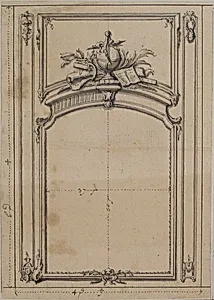
Design for Wall Paneling
ca. 1750–70
Medium
Pen and gray ink, brush and gray wash.
Dimensions
7 3/4 x 5 1/2 in. (19.7 x 14.0 cm)
Classification
Drawings|Ornament & Architecture
Department
Drawings and Prints
Museum
Metropolitan Museum of Art, New York, NY
Credit
The Elisha Whittelsey Collection, The Elisha Whittelsey Fund, 1948
Accession Number
48.148(24)
Rights
Public Domain
Tags
Art Historical Context
This delicate *Design for Wall Paneling created by an anonymous French artist around 1750–70, captures the exuberant spirit of the Rococo era in mid-18th-century France. During the reign of Louis XV, opulent interiors adorned the salons of the aristocracy, where intricate boiseries—carved wooden paneling—transformed walls into sculptural masterpieces. Such designs emphasized asymmetry, scrolling motifs, and playful ornamentation, reflecting a shift from the grandeur of Baroque toward lighter, more intimate elegance inspired by nature and fantasy. Rendered in pen and gray ink with brush and gray wash on a modest 7 3/4 x 5 1/2-inch sheet, this drawing exemplifies the preparatory techniques of the time. The fine pen lines delineate precise architectural elements, while subtle gray washes add depth and shadow, allowing designers to visualize texture and light on carved surfaces. These functional yet artistic sketches bridged the gap between concept and execution, guiding artisans in crafting luxurious rooms for châteaux and hôtels particuliers. Housed in the Metropolitan Museum of Art's Drawings and Prints department, this piece from The Elisha Whittelsey Collection highlights the unsung role of anonymous draftsmen in shaping French decorative arts. It invites us to appreciate the meticulous planning behind the era's lavish environments, where every panel contributed to a symphony of refinement and whimsy.
About the Artist
Anonymous, French, 18th century · 1700–1800
The artist known as Anonymous, French, 18th century, represents a collective of unidentified talents active roughly between 1700 and 1800, a period of profound artistic evolution in France from the opulent Rococo to the austere dawn of Neoclassicism and Revolutionary fervor. Little is documented about their personal training or mentors, as their anonymity obscures individual biographies, though th...