
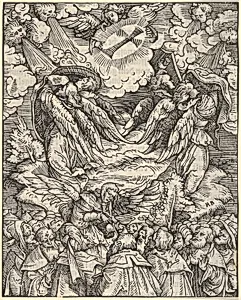
Designation of the Elect, from The Apocalypse
1523–24
Medium
Woodcut
Dimensions
Sheet: 6 7/16 × 5 3/16 in. (16.4 × 13.1 cm)
Classification
Prints
Department
Drawings and Prints
Museum
Metropolitan Museum of Art, New York, NY
Credit
The Elisha Whittelsey Collection, The Elisha Whittelsey Fund, 1963
Accession Number
63.705.6
Rights
Public Domain
Tags
Art Historical Context
"Designation of the Elect, The Apocalypse" is a captivating woodcut print created around 1523–24 by the renowned German artist Hans Burgkmair, in collaboration with printer Silvan Otmar. Measuring just 6 7/16 × 5 3/16 inches, this intimate sheet belongs to a series inspired by the Book of Revelation in the Bible. It depicts a dramatic moment of divine selection, featuring angels, a prominent cross, and symbolic elements of judgment and salvation, evoking the end-times fervor of the early Reformation era. Burgkmair, a master of the German Renaissance and a peer of Albrecht Dürer, excelled in woodcuts, a technique where intricate designs were carved into wood blocks and inked for printing. This method revolutionized art by making high-quality images affordable and widely distributable, especially religious visions like those of the Apocalypse. Produced in Augsburg, a hub of early printmaking, the work reflects the period's intense religious and cultural anxieties amid Luther's reforms. Housed in the Metropolitan Museum of Art's Drawings and Prints department, this piece from The Elisha Whittelsey Collection highlights how such prints educated and inspired laypeople, blending artistry with profound spiritual messaging. A testament to Renaissance innovation, it invites visitors to ponder humanity's place in cosmic drama.
About the Artist
Hans Burgkmair|Silvan Otmar · 1473–1531
Hans Burgkmair the Elder (1473–1531) was a German painter and printmaker who became one of the leading artists of the Renaissance in Augsburg. Born into a family of painters — his father, Thoman Burgkmair, was a respected artist — he likely received his initial training in his father's workshop. He may also have studied with Martin Schongauer in Colmar, and a probable visit to Italy around 1507 ex...