
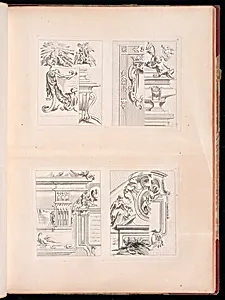
Designs After Architecture Fragments
Medium
Bound print
Classification
Bound print
Department
Smithsonian Collection
Museum
Smithsonian American Art Museum
Credit
Purchased for the Museum by the Advisory Council
Accession Number
1921-6-216-138
Rights
Public Domain
About this artwork
Research in Progress
Art Historical Context
Gilles-Marie Oppenord (1672–1742), a prominent French architect and ornamental designer, left a lasting legacy in the Rococo, known for its elegant curves, playful motifs, and intricate detailing. *Designs After Architecture Fragments*, published posthumously between 1749 and 1761, captures his fascination with classical architectural elements reimagined through a decorative lens. As a bound print—a compiled volume of engraved plates—this work served as a pattern book, offering artisans, architects, and decorators ready-to-use motifs inspired by ancient fragments. These designs reflect the 18th-century French enthusiasm for blending antiquity with opulent fantasy, bridging Rococo exuberance and emerging Neoclassicism. Oppenord's flowing arabesques and sculptural vignettes would have influenced furniture makers, silversmiths, and interior designers across Europe, disseminating his innovative style through print. Acquired by the Smithsonian American Art Museum via the Advisory Council, this rare volume highlights the era's printmaking prowess, where copperplate engravings preserved ephemeral sketches for enduring. Though research continues, *Designs After Architecture Fragments* invites visitors to trace the of ornament from stone ruins to gilded salons, embodying the creative spirit of Enlightenment-era design.