
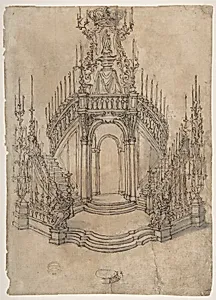
Designs for a Funerary Monument with Stairs (Recto). Various Funerary Monument Designs (Verso).
1652–1725
Medium
Pen and brown ink, brush and gray wash, over traces of graphite or black chalk. Verso: pen and brown ink over traces of graphite
Dimensions
sheet: 11 5/8 x 8 3/8 in. (29.5 x 21.3 cm)
Classification
Drawings
Department
Drawings and Prints
Museum
Metropolitan Museum of Art, New York, NY
Credit
The Elisha Whittelsey Collection, The Elisha Whittelsey Fund, 1949
Accession Number
49.63.279
Rights
Public Domain
Tags
Art Historical Context
Giovanni Battista Foggini (2–1725), a leading Florentine Baroque artist and architect, crafted this double-sided drawing as preparatory designs for grand funerary monuments. The recto features a monumental structure with dramatic stairs, evoking the theatricality of Baroque architecture, while the verso varied concepts, showcasing the artist's iterative creative process. Executed in pen and brown ink with brush gray wash over faint graphite underdrawing, the sheet measures 11⅝ × 8⅜ inches and exemplifies 17th-century draftsmanship techniques that convey depth, shadow, and sculptural volume. Foggini's designs reflect the opulent Baroque era in Italy, where funerary monuments blended architecture and sculpture to honor the deceased with eternal splendor—often commissioned for churches by patrons like the Medici family, for whom he worked extensively. The use of brown ink and subtle gray wash mimics stone textures and light effects, bridging drawing and three-dimensional realization, a hallmark of architectural sketches from this period. Housed in the Metropolitan Museum of Art's Drawings and Prints department (The Elisha Whittelsey Collection, 1949), this work offers visitors a glimpse into the meticulous planning behind Baroque memorials, highlighting Foggini's mastery in fusing artistic innovation with commemorative tradition.
About the Artist
Giovanni Battista Foggini · 1652–1725
**Giovanni Battista Foggini** (1652–1725) was a leading Italian sculptor and architect of the late Baroque period, born in Florence within the Grand Duchy of Tuscany. He began his career under the patronage of the Medici family, who sponsored his artistic training. In 1673, at the age of 21, Cosimo III de' Medici sent the young Foggini to Rome to join the newly founded Accademia Fiorentina, where ...