
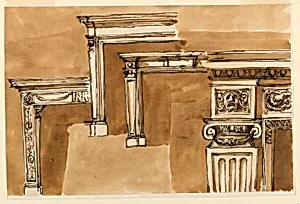
Designs for a Mantelpiece
1746–1809
Classification
interiors
Department
Smithsonian Collection
Museum
Smithsonian American Art Museum
Credit
Museum purchase through gift of various donors and from Eleanor G. Hewitt Fund
Accession Number
1938-88-1682
Rights
Public Domain
About this artwork
Research in Progress
Art Historical Context
Giuseppe Barberi (1746–1809), a prominent Italian architect and designer active in Rome during the late 18th century, created *Designs for a Mantel* as part of his explorations in interior architecture. This work, housed in the Smithsonian American Art's collection (acquired through museum purchase and the Eleanor G. Hewitt Fund falls under the classification of "interiors," highlighting Barberi's expertise in ornamental elements that defined elegant homes of the era. Mantelpieces were focal points in period interiors, serving both functional and decorative roles above fireplaces—the heart of domestic life. Barberi's designs likely reflect the neoclassical tastes of his time, blending symmetry, classical motifs, and refined proportions to elevate everyday spaces. Though the medium remains unidentified amid ongoing research, such drawings were typically rendered in ink, wash, or gouache on paper, allowing architects to propose intricate carvings, moldings, and sculptural details. This piece offers a window into 18th-century Italian design's influence on global interiors, underscoring how mantelpieces symbolized status and craftsmanship. Visitors can appreciate its role in preserving the evolution of architectural ornamentation, even as scholars continue to uncover more about Barberi's innovative contributions.