
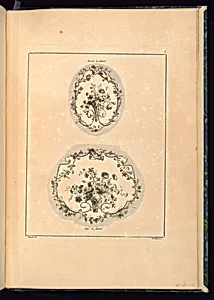
Designs for Armchair Covers (Back and Seat)
Medium
Classification
Department
Smithsonian Collection
Museum
Smithsonian American Art Museum
Credit
Purchased for the Museum by the Advisory Council
Accession Number
1921-6-389-114
Rights
Public Domain
About this artwork
Research in Progress
Art Historical Context
Pierre Ranson's *Designs for Armchair (Back and Seat)*, created in 1778, offers a glimpse into the elegant of French decorative arts during the late Ancien Régime. As a skilled French engraver (1736–1786), Ranson in ornamental prints that captured the refined tastes of the aristocracy under Louis XVI. This work, now housed in the Smithsonian American Museum's Print Collection (purchased by the Advisory Council), presents intricate patterns for upholstery, highlighting the meticulous design process behind luxurious period furniture. Printed in 1778, the piece reflects the transition from opulent Rococo flourishes to the emerging Neoclassical restraint, where symmetry and classical motifs began to influence even everyday luxury items like armchair coverings. Prints like this were essential tools for artisans, allowing furniture makers and textile producers across Europe to replicate high-fashion designs affordably. Ranson's technique—likely intricate line engraving—ensured precise, reproducible motifs that could inspire sumptuous silk or velvet coverings, evoking the grandeur of Versailles salons. Though research on this specific print is ongoing, it underscores the print medium's role in democratizing elite design, bridging the gap between royal workshops and wider markets. A charming artifact of 18th-century craftsmanship, it invites us to imagine guests reclining in chairs adorned with these very patterns.