
Designs for Door Hardware
ca. 1775–85
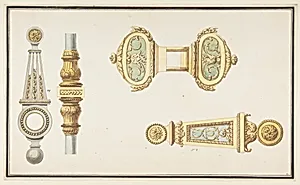
Medium
Graphite, pen and gray ink, brush and brown, blue, yellow, gray, and green wash. Framing lines in pen and black ink.
Dimensions
10 15/16 x 18 1/16 in. (27.8 x 45.9 cm)
Classification
Drawings
Department
Drawings and Prints
Museum
Metropolitan Museum of Art, New York, NY
Credit
Gift of Raphael Esmerian, 1961
Accession Number
61.680.3.2
Rights
Public Domain
Art Historical Context
This elegant sheet of designs for door hardware, created by an anonymous French artist around 1775–85, captures the refined decorative sensibilities of late eighteenth-century France. Rendered in graphite, pen and ink, and delicate washes of blue, yellow, green, and gray, the drawing presents a series of ornate handles, escutcheons, and keyhole plates. These would have adorned the interiors of aristocratic homes and hôtels particuliers during the transition from the playful curves of Rococo to the more restrained elegance of Neoclassicism under Louis XVI. Such design drawings played a vital role in the applied arts, serving as working models for metalworkers and cabinetmakers. The careful use of colored washes allowed the artist to suggest different materials—perhaps gilt bronze, steel, or enameled surfaces—helping patrons visualize how the hardware would complement paneled rooms and fine furniture. Though the creator remains unknown, the sheet reflects the collaborative nature of French decorative production, where anonymous draftsmen contributed to the luxurious environments of the period. Now housed in the Metropolitan Museum’s Department of Drawings and Prints, this work offers a fascinating glimpse into the meticulous planning behind everyday objects that were also works of art.
About the Artist
Anonymous, French, 18th century · 1700–1800
The artist known as Anonymous, French, 18th century, represents a collective of unidentified talents active roughly between 1700 and 1800, a period of profound artistic evolution in France from the opulent Rococo to the austere dawn of Neoclassicism and Revolutionary fervor. Little is documented about their personal training or mentors, as their anonymity obscures individual biographies, though th...