
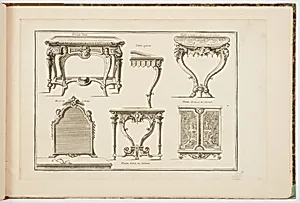
Designs for Furniture
Classification
Department
Smithsonian Collection
Museum
Smithsonian American Art Museum
Credit
Purchased for the Museum by the Advisory Council
Accession Number
1921-6-449-5
Rights
Public Domain
About this artwork
Research in Progress
Art Historical Context
André-Charles Boulle (1642–1732),'s preeminent cabinetmaker and *ébéniste du roi* Louis XIV, created these *Designs for Furniture* 1715, during the opulent twilight of the Sun King's reign and the dawn of the Régence style. As a master innovator, Boulle elevated furniture design to high art, blending Baroque grandeur with exquisite craftsmanship. Working in the royal workshops at the Gobelins, he pioneered "Boulle work"—intricate marquetry inlays of tortoiseshell, brass, pewter, and exotic woods that adorned commodes, cabinets, and tables for Versailles' elite. Rendered as a print, this artwork likely served as a pattern sheet for artisans, disseminating Boulle's visionary motifs—scrolling acanthus leaves, mythological figures, and gilded bombé curves—across Europe. Such designs fueled the luxury furniture trade, influencing Rococo developments and embodying absolutist France's cultural prestige. Boulle's engraved patterns were prized collectibles, bridging design and dissemination in an era before mass production. Acquired by the Smithsonian American Art Museum through its Advisory Council, this piece highlights the transatlantic appeal of French decorative arts. Though research continues, it invites visitors to envision the shimmering masterpieces these lines inspired, a testament to Boulle's enduring legacy in the history of design.