
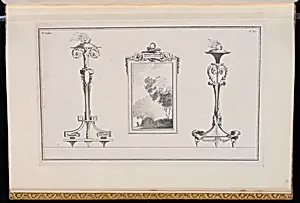
Designs for Incense Burners and a Frame
Classification
Department
Smithsonian Collection
Museum
Smithsonian American Art Museum
Credit
Purchased for the Museum by the Advisory Council
Accession Number
1921-6-482-47
Rights
Public Domain
About this artwork
Research in Progress
Art Historical Context
Henri Sallembier (ca. 1753–1820), a prominent French designer and engraver created *Designs for Incenseers and a Frame* 1778, a delicate print now housed in the Smithsonian American Art Museum Active during the late Ancien Régime,mbier specialized in ornamental designs for luxury goods, often collaborating with the Sè porcelain manufactory. This work exemplifies the neoclassical style sweeping Europe, drawing on ancient Greek and Roman motifs with clean lines, symmetry, and refined elegance—hallmarks of the Louis XVI era's opulent decorative arts. As a print, likely an engraving, the piece served a practical purpose: disseminating precise designs to artisans crafting high-end furnishings. Incense burners, or *brûle-parfum*, were status symbols in aristocratic homes and churches, evoking exotic scents amid gilded interiors, while the frame design hints at complementary decorative schemes for mirrors or portraits. Produced on the eve of the French Revolution, it captures a fleeting moment of pre-revolutionary splendor. Acquired through the museum's Advisory Council, this rarity bridges European craftsmanship with American collections, underscoring transatlantic tastes in the early republic. Though research continues, it invites us to appreciate how printed designs fueled the era's lavish material culture.