
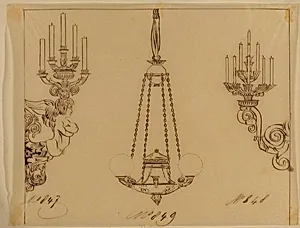
Designs for Two Sconces and a Chandelier
19th century
Medium
Pen and brown ink
Dimensions
image: 6 15/16 x 9 1/8 in. (17.6 x 23.1 cm)
Classification
Drawings
Department
Drawings and Prints
Museum
Metropolitan Museum of Art, New York, NY
Credit
Rogers Fund, 1966
Accession Number
66.631.67
Rights
Public Domain
Tags
Art Historical Context
Step into the opulent world of 19-century French interiors with *Designs for Two Sconces and a Chandelier an exquisite anonymous drawing from the Metropolitan Museum of Art. Created precise pen and brown ink on (measuring 6 15/16 x 9 1/8 inches), this sheet showcases meticulous sketches of elegant wall-mounted sconces and a grand chandelier. Such designs were essential for illuminating lavish salons, ballrooms, and public spaces during France's Second Empire and Belle Époque eras, when gas and early electric lighting transformed architecture and decor. The anonymous artist's work reflects the era's passion for eclecticism, blending neoclassical symmetry with ornate flourishes inspired by Gothic, Renaissance, and Oriental motifs. Pen and brown ink—a favored medium for architects and designers—allowed for sharp, detailed lines that conveyed texture, shadow, and proportion, serving as blueprints for skilled craftsmen in bronze, crystal, or ormolu. These preparatory drawings highlight the collaborative artistry behind functional luxury, bridging fine art and decorative trades. Acquired through the Rogers Fund in 1966, this piece from the Met's Drawings and Prints department offers a glimpse into the unsung creativity of 19th-century workshops. Imagine these fixtures flickering to life in a Parisian hôtel particulier, casting a warm glow on gilded walls!
About the Artist
Anonymous, French, 19th century · 1800–1900
**Anonymous, French, 19th Century (ca. 1800–1900)** The artist cataloged as Anonymous, French, 19th century embodies the enigmatic yet essential contributions of unidentified creators to France's vibrant 19th-century art world. Active roughly between 1800 and 1900, this figure—or potentially collective workshop—produced a diverse array of works amid the nation's transition from Neoclassicism thro...