
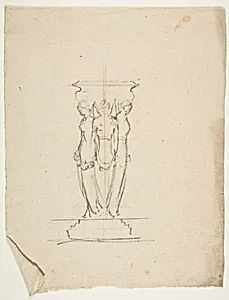
Desing for a base or support with three female figures
19th century
Medium
Black chalk on laid paper
Dimensions
sheet: 10 1/16 x 7 5/8 in. (25.5 x 19.4 cm)
Classification
Drawings
Department
Drawings and Prints
Museum
Metropolitan Museum of Art, New York, NY
Credit
Gift of János Scholz, 1961
Accession Number
61.636.47
Rights
Public Domain
Tags
Art Historical Context
This delicate 19th-century drawing, titled *Design for a Base or with Three Female Figures*, is a captivating example of anonymous French draftsmanship from the Metropolitan Museum of Art's Drawings and Prints collection. Created black chalk on laid paper traditional medium prized for its subtle texture and ability to capture soft tonal gradations—the sheet measures a modest 10 1/16 x 7 5/8 inches. preparatory sketches were essential in the era's workshops, guiding sculptors and craftsmen in crafting ornate furniture pedestals, candelabras, or architectural supports adorned with graceful female forms, evoking classical ideals of beauty and harmony. In 19th-century France, amid the Romantic and neoclassical revivals, such designs reflected a flourishing decorative arts scene influenced by antiquity and the grandeur of the Empire style. Black chalk allowed the artist to model the figures' flowing drapery and poised anatomies with fluid precision, hinting at allegorical or decorative motifs common in bourgeois interiors and public monuments. The three women, likely symbolizing virtues or graces, embody the period's fascination with the female form as a vessel for elegance and narrative. Generously gifted by János Scholz in 1961, this work offers a window into the collaborative artistry behind opulent 19th-century objects, reminding us how sketches like this bridged imagination and craftsmanship in French design tradition.
About the Artist
Anonymous, French, 19th century · 1800–1900
**Anonymous, French, 19th Century (ca. 1800–1900)** The artist cataloged as Anonymous, French, 19th century embodies the enigmatic yet essential contributions of unidentified creators to France's vibrant 19th-century art world. Active roughly between 1800 and 1900, this figure—or potentially collective workshop—produced a diverse array of works amid the nation's transition from Neoclassicism thro...