
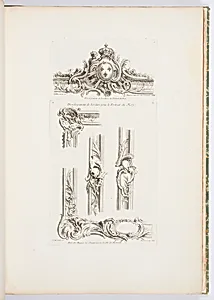
Development de bordures du Portrait du Roy, Cartouche aux armes du roi..., 4th plate, pl. 38 in Oeuvre de Juste-Aurele Meissonnier
Medium
ornament
Classification
ornament
Department
Smithsonian Collection
Museum
Smithsonian American Art Museum
Credit
Purchased for the Museum by the Advisory Council
Accession Number
1921-6-212-13-a
Rights
Public Domain
About this artwork
Research in Progress
Art Historical Context
Juste-Aurèle Meissonnier (1695–1750), a visionary Franco-Italian designer born in and active in Paris, was a master of the exuberant Rococo style. 1748 engraving, the fourth plate (pl. 38) from his influential *Oeuvre de Juste-Aurèleissonnier*, titled *Développement de bordures du du Roy, Cartouche armes du roi...*, his genius for ornamental design. Created late in his career, it features intricate border developments and a royal cartouche—likely intended to frame a portrait of King Louis XV—bursting with scrolling foliage, asymmetrical motifs, and playful flourishes typical of Rococo's whimsical elegance. As a printed ornament, this work exemplifies the era's obsession with lavish decoration, bridging architecture, furniture, and graphic arts. Meissonnier's engravings were pattern books for artisans across Europe, disseminating his innovative, fluid lines that rejected Baroque rigidity for organic fantasy. Produced amid France's opulent Ancien Régime, it reflects royal patronage and the cultural height of Versailles-inspired splendor. Now in the Smithsonian American Art Museum's collection—purchased by the Advisory Council—this plate invites us to appreciate how such designs adorned palaces and objects, embodying 18th-century France's artistic joie de vivre. Research continues to uncover more about its precise context, but its technical precision and imaginative verve remain timeless.