
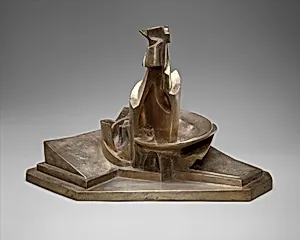
Development of a Bottle in Space
1913, cast 1950
Medium
Bronze
Dimensions
15 1/2 × 23 3/4 × 12 1/2 in. (39.4 × 60.3 × 31.8 cm)
Classification
Sculpture
Department
Modern and Contemporary Art
Museum
Metropolitan Museum of Art, New York, NY
Credit
Bequest of Lydia Winston Malbin, 1989
Accession Number
1990.38.2
Rights
Public Domain
Art Historical Context
Umberto Boccioni's *Development of a Bottle in* (1913, cast 1950) stands as a cornerstone of Futism, the revolutionary Italian art movement that celebrated speed, technology, and the dynamism of modern life. Created during Futurism's peak, this bronze sculpture embodies Boccioni's radical vision to capture not just an object, but its *evolution* through time and space. Rejecting static representation, Boccioni fused the bottle's form with its surrounding environment, suggesting motion and simultaneity in a single, fluid mass. Cast in bronze—a durable medium that preserves the original plaster's intricate details—this 15½ × 23¾ × 12½-inch work showcases Futurist sculptural techniques like fragmentation and interpenetration. Lines blur between the bottle and air, evoking the fourth dimension and challenging traditional sculpture's solidity. It's a manifesto in metal, illustrating Boccioni's 1913 call for art to convey "plastic dynamism." Today, this piece graces the Metropolitan Museum of Art's Modern and Contemporary Art department, thanks to the bequest of collector Lydia Winston Malbin in 1989. A testament to early 20th-century innovation, it invites visitors to ponder how everyday objects can pulse with energy, bridging the gap between perception and reality.
About the Artist
Umberto Boccioni · 1882–1916
Umberto Boccioni (1882–1916) was an Italian painter and sculptor who became the leading artist and principal theorist of the Futurist movement. Born in Reggio Calabria, he studied in Rome under the Divisionist painter Giacomo Balla and was deeply influenced by Post-Impressionism before encountering the ideas of Filippo Tommaso Marinetti, whose 1909 Futurist Manifesto catalyzed Boccioni's artistic ...