
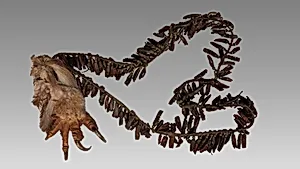
Dew Claw Rattle
Unknown Artist
19th century
Medium
Dewclaws, leather, rawhide, brass, eagle's claw and feathers, deer's tail
Dimensions
L. (ends tied together) ± 73.7cm (29in.); L (outstretched) 147.3 cm (58 in.)
Classification
Idiophone-Shaken-rattle
Culture
Native American (Osage)
Department
Musical Instruments
Museum
Metropolitan Museum of Art, New York, NY
Credit
The Crosby Brown Collection of Musical Instruments, 1889
Accession Number
89.4.571
Rights
Public Domain
Art Historical Context
This striking *Dew Claw Rattle* the 19th-century Osage Nation exemplifies the ingenuity of Native American craftsmanship in musical instruments. Crafted by an unknown artist, it an idiophone—a shaken rattle—made from dewclaws (the small hooves of deer), leather,hide, brass, an eagle's claw, feathers and a deer's tail. When tied together, it measures about 29 inches (73.7 cm); outstretched, it extends to an impressive 58 inches (.3 cm), suggesting it was designed for dynamic use, perhaps looped around the body or wielded in performance. In Osage culture, such rattles held profound ceremonial significance, producing a distinctive clattering sound to accompany dances, rituals, and storytelling. The materials reflect deep connections to nature: eagle feathers symbolize spiritual power, while deer elements honor hunted animals, blending utility with sacred symbolism. This piece highlights the Osage's mastery of rawhide stretching and natural assembly techniques, creating resonant idiophones without modern tools. Acquired as part of The Crosby Brown Collection of Musical Instruments in 1889, it now resides in the Metropolitan Museum of Art's Department of Musical Instruments. Visitors are invited to imagine its rhythmic pulse echoing through Osage gatherings, a testament to enduring cultural traditions.