
Dialectica from Seven Liberal Arts
16th century
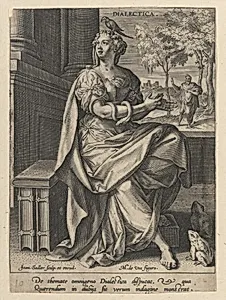
Medium
Engraving
Dimensions
5 3/4 x 4 1/4 in. (14.6 x 10.8 cm)
Classification
Prints
Department
Drawings and Prints
Museum
Metropolitan Museum of Art, New York, NY
Credit
The Elisha Whittelsey Collection, The Elisha Whittelsey Fund, 1949
Accession Number
49.95.1494
Rights
Public Domain
Tags
Art Historical Context
This engraving, titled *Dialectica* from the series *Seven Liberal Arts*, captures the Renaissance fascination with classical learning and the trivium of grammar, rhetoric, and logic. Created in the 16th century by designer Maerten de Vos and engraver Johann Sadeler I, it personifies dialectic—the art of reasoned argument—through an allegorical female figure. The collaborative print reflects the era’s vibrant Antwerp workshops, where painters and printmakers worked together to spread educational and moral ideas across Europe. Measuring just 5 ¾ by 4 ¼ inches, the engraving employs fine line work typical of the period to render symbolic creatures—serpents, frogs, and birds—that surround the central woman. These motifs underscore dialectic’s role in discerning truth amid complexity. As part of a larger set on the Liberal Arts, the print would have served both as an instructional image for scholars and as a decorative object for educated collectors. Printmaking techniques like engraving allowed such compositions to reach wide audiences, democratizing knowledge in an age before widespread literacy in images. Today, this work in the Metropolitan Museum’s collection invites viewers to consider how Renaissance artists visualized intellectual virtues through intricate, emblematic detail.
About the Artist
Johann Sadeler I|Maerten de Vos · 1550–1601
**Johann Sadeler I (also known as Jan or Johannes Sadeler), born in Brussels in 1550 and active until his death in Venice in 1600, stands as a pivotal figure in the Sadeler family, the most prolific dynasty of Flemish engravers and print publishers in Northern Europe during the late sixteenth and early seventeenth centuries.** As the eldest of three brothers—including Aegidius I and Raphael I—he ...