
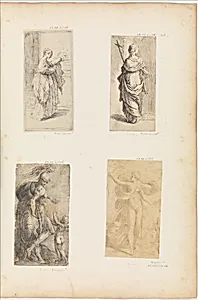
Diana
ca. 1536–38 (?)
Medium
Etching
Classification
Prints
Department
Drawings and Prints
Museum
Metropolitan Museum of Art, New York, NY
Credit
Harris Brisbane Dick Fund, 1927
Accession Number
27.78.2(140)
Rights
Public Domain
Tags
Art Historical Context
Behold *Diana*, a captivating etching by Venetian artist Andrea Schiavone ( Meldola), created around 1536–38. This print, housed in the Metropolitan Museum of's Drawings and Prints departmentacquired via the Harris Dick Fund in 192), showcases Schiavone's mastery of the relatively new etching technique. Unlike the rigid lines of traditional engraving, etching allowed artists like him—active in Titian's circle—to achieve fluid, expressive strokes, blending painterly effects with the precision of printmaking. The composition centers on the mythological figure of Diana, the Roman goddess of the hunt and chastity, accompanied by Cupid, the mischievous god of love. A prominent cross adds an intriguing layer, possibly symbolizing a fusion of pagan mythology and emerging Christian iconography during the Renaissance. This interplay reflects the era's cultural tensions, as Venetian artists explored classical themes amid the Catholic Reformation. Schiavone's innovative use of etching democratized his dynamic Mannerist style, making complex narratives accessible beyond oil paintings. Visitors, gaze closely at the intricate lines capturing divine tension— a testament to 16th-century Venice's artistic ferment. (198 words)
About the Artist
Andrea Schiavone (Andrea Meldola) · 1510–1563
Andrea Schiavone, born Andrea Meldolla around 1510 or 1515 in Zara (modern Zadar, Croatia), in Venetian-ruled Dalmatia, hailed from a family rooted in Meldola near Forlì in Romagna, Emilia-Romagna. His father, Simon Meldolla, served as a garrison commander there, and both parents originated from Meldola, where the family held property into the early 16th century. Nicknamed "Schiavone"—"the Slav"—a...