
Dice
Unknown Artist
10th–11th century
Medium
Jet
Dimensions
H. 1 1/2 in. (3.8 cm.) W. 1/2 in. ( 1.3 cm)
Classification
Gaming pieces
Department
Islamic Art
Museum
Metropolitan Museum of Art, New York, NY
Credit
Pfeiffer Fund, 1972
Accession Number
1972.119.4
Rights
Public Domain
Tags
Art Historical Context
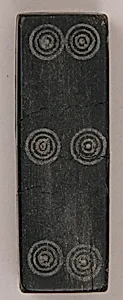
Nestled in the Metropolitan Museum of Art's Islamic collection, this petite pair of dice, crafted from jet in the 10th–11th century, offers a glimpse into everyday life in the medieval Islamic world. Measuring just 1 1/2 inches high 1/2 inch wide, these gaming pieces are remarkably small yet finely worked. Jet, a dense black fossilized wood prized for its smooth polish and lightweight durability, was a favored material for portable objects like these, allowing them to be easily carried for travel or leisure. During the Abbasid era and beyond, games of chance and skill were popular across Islamic societies, from bustling bazaars in Baghdad to courts in Cordoba. Dice like these would have been used in backgammon (tavla) or similar board games, blending recreation with social bonding. Though Islamic teachings cautioned against gambling, recreational gaming flourished, reflecting a vibrant cultural tapestry. Acquired through the Pfeiffer Fund in 1972, these unassuming dice highlight the artistry in utilitarian objects. Their precision-carved pips and glossy finish showcase the era's skilled lapidary techniques, turning simple coal-like jet into enduring playthings that survived centuries. A charming reminder that history's joys often come in the smallest packages!