
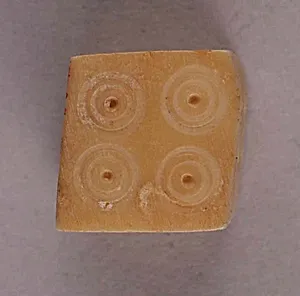
Dice
Unknown Artist
9th–10th century
Medium
Bone; incised
Dimensions
H. 3/8 in. (0.9 cm) W. 3/8 in. (0.9 cm) D. 3/8 in. (0.9 cm)
Classification
Gaming pieces
Department
Islamic Art
Museum
Metropolitan Museum of Art, New York, NY
Credit
Rogers Fund, 1948
Accession Number
48.101.211f
Rights
Public Domain
Tags
Art Historical Context
This small bone die, measuring just three-eighths of an inch each side, offers a fascinating glimpse into everyday leisure during the 9th and 10th centuries in the Islamic world. Crafted from bone and decorated with incised markings, the cube would have been used for games of chance, reflecting a long tradition of gaming that spanned ancient civilizations and continued to thrive under Islamic rule. Such objects highlight how mathematical precision—evident in the balanced six-sided form—intersected with daily entertainment across diverse regions. The incised technique, involving careful carving into the bone surface, allowed artisans to create durable, portable gaming pieces without elaborate tools. Housed in the Metropolitan Museum’s Department of Islamic Art, this modest artifact reminds us that artistic skill extended beyond grand mosques and manuscripts to the functional items that enriched social life. Acquired through the Rogers Fund in 1948, it invites visitors to appreciate the ingenuity and cultural continuity embedded in even the smallest historical objects.