
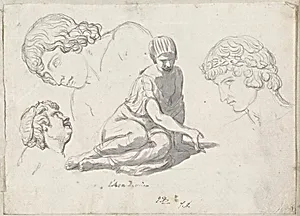
Dice-Thrower and Other Studies after Ancient Sculptures
1775/80
Medium
black chalk and gray wash on laid paper
Dimensions
overall: 15.2 x 21.1 cm (6 x 8 5/16 in.)
Classification
Drawing
Department
CG-E
Museum
National Gallery of Art, Washington, D.C.
Credit
Patrons' Permanent Fund
Accession Number
1998.105.1.c
Rights
Public Domain
Art Historical Context
In the late 1770s, as a young artist in Rome, Jacques-Louis David honed his craft through meticulous studies of classical antiquity, as seen in *Dice-Thrower and Other Studies after Ancient Sculptures* (ca. 1775/80). This intimate drawing on laid paper captures dynamic figures—a dice-thrower in mid-gesture alongside other sculptural motifs—echoing Greco-Roman masterpieces like those from the Borghese collections. David's early exposure to these ancient works fueled his lifelong passion for ideal anatomy and heroic form, laying the groundwork for his revolutionary Neoclassical paintings. Rendered in black chalk with subtle gray wash, the 15.2 x 21.1 cm sheet showcases David's virtuoso technique: crisp lines define muscular contours, while washes add depth and volume, mimicking the three-dimensionality of marble sculptures. This medium was ideal for preparatory sketches, allowing artists to analyze light, shadow, and movement without the permanence of paint. Housed in the National Gallery of Art, this work reveals David's pivotal transition from Rococo ornamentation to austere classicism, influencing the French Revolution's visual language. For visitors, it's a window into the disciplined eye that would later produce icons like *The Oath of the Horatii*, reminding us how copying the past forged the future of art.
About the Artist
Jacques-Louis David · 1748–1825
Jacques-Louis David, born on August 30, 1748, in Paris, emerged as the preeminent French painter of Neoclassicism, a movement emphasizing austere lines, moral clarity, and classical antiquity as antidotes to Rococo frivolity. Orphaned young after his father's death in a duel, he was raised by prosperous architect uncles and educated at the Collège des Quatre-Nations. Defying family expectations, D...