
Die Jagd des Agamemnon
1763
Medium
Öl auf Leinwand
Dimensions
63 × 63 cm (Bildfeld kreisförmig)
Classification
Gemälde
Department
Belvedere Collection
Museum
Belvedere
Credit
Belvedere, Vienna
Accession Number
2064
Rights
Public Domain
About this artwork
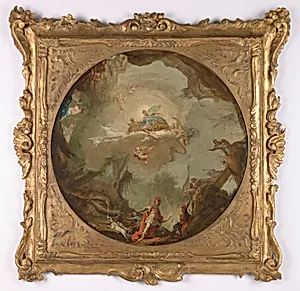
Bei dieser Ölskizze handelt es sich um den Entwurf für das 1766 entstandene Deckengemälde des Dianatempels, einem Gartenpavillon in Laxenburg. In der unteren Bildzone ist Agamemnon zu sehen, der eine Diana geweihte Hirschkuh erlegt hat. Er schreckt von der zürnenden Göttin, die sich auf einem von weißen Hirschen gezogenen Wagen befindet, zurück. An den Rändern der Darstellung sind Äolus und Neptun sowie links wohl Iphigenie und ihre Gespielinnen zu entdecken.
Art Historical Context
**Die Jagd des Agnon** (The Hunt of Agamemnon), an enchanting 1763 oil sketch on canvas by Austrian Rococo artist Vinzenz Fischer, measures a perfect 63 × 63 cm in a circular format—ideal for its destined role as a ceiling painting. Created as a preparatory design for the opulent Dianatempel pavilion in Laxenburg, an imperial garden retreat near Vienna favored by the Habsburgs, this work captures Fischer's mastery of dynamic composition tailored to architectural spaces. Completed in 1766 as a fresco overhead, the sketch exemplifies 18th-century decorative arts, blending illusionistic perspective with the grandeur of rococo ornamentation. At the center, Agamemnon recoils in terror after slaying a sacred hind dedicated to the goddess Diana (Artemis in Greek myth), whose wrath would demand his daughter Iphigenia's sacrifice to appease the gods before the Trojan War. Diana appears furious atop a chariot drawn by white hinds, flanked by wind god Aeolus and sea god Neptune at the edges, with Iphigenia and her companions glimpsed on the left. This mythological drama, drawn from classical sources like Ovid, underscores themes of hubris and divine retribution, popular in Enlightenment-era art for their moral and dramatic appeal. Fischer's fluid brushwork and vibrant colors in this bozzetto (preliminary oil study) highlight his skill in fresco planning, bringing ancient legends to life in a playful yet poignant rococo style. Housed in Vienna's Belvedere Collection, it offers visitors a window into Habsburg patronage and the era's fusion of myth, nature, and neoclassical elegance.