
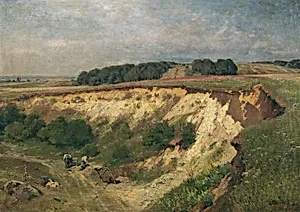
Die Sandgrube
1900
Medium
Öl auf Leinwand
Dimensions
55 x 77,5 cm
Classification
Gemälde
Department
Belvedere Collection
Museum
Belvedere
Credit
Belvedere, Vienna
Accession Number
2491
Rights
Public Domain
Art Historical Context
**Die Sandgrube (The Sand Pit)**, painted by Hugo Darnaut in 1900, captures a slice of everyday life in the Viennese countryside through oil on canvas (55 x 77.5 cm). Housed in the Belvedere Collection in Vienna, this work exemplifies Darnaut's mastery of landscape painting, blending natural beauty with subtle human activity. The title suggests a scene of a sandy quarry, likely along the Danube region that the artist frequented, rendered with earthy tones and atmospheric depth typical of his outdoor studies. Hugo Darnaut (1850–1937), a prominent Austrian painter associated with the Hagenbund group, drew inspiration from Impressionism while rooting his style in the Biedermeier tradition. Around 1900, as Vienna buzzed with Secessionist innovation, Darnaut focused on luminous effects of light and the interplay of labor and landscape, using loose brushwork in oil to evoke the transience of natural elements. His technique highlights the tactile quality of sand and foliage, inviting viewers to feel the warmth of the sunlit pit. This painting holds cultural significance as a window into fin-de-siècle Austria, where industrialization met idyllic nature. In the Belvedere's esteemed collection—home to Klimt and Schiele—*Die Sandgrube* offers a grounded contrast, celebrating the ordinary with poetic realism. A must-see for those exploring Vienna's artistic heritage! (198 words)