
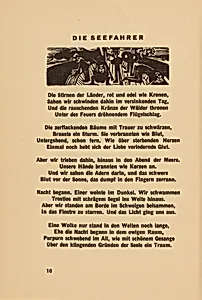
Die Seefahrer (The Seafarer) (headpiece, page 10) from Georg Heym: Umbra Vitae (Georg Heym: The Shadow of Life)
Medium
woodcut from a bound volume with 50 woodcuts (including cover and front and back endpapers) on wove paper
Dimensions
book: 23.8 × 16.5 × 1.2 cm (9 3/8 × 6 1/2 × 1/2 in.)
Classification
Volume
Department
CG-W
Museum
National Gallery of Art, Washington, D.C.
Credit
Gift of Ruth Cole Kainen
Accession Number
2012.92.41.9
Rights
Public Domain
Art Historical Context
**Die Seefahrer (The Seafarer)**, a striking woodcut headpiece on page 10 of Ernst Ludwig Kirchner's *Umbra Vitae (Georg Heym: The Shadow of Life)*, captures the raw intensity of early 20th-century Expressionism. Created in 1924, this image is part of a lavish bound volume containing 50 woodcuts—including the cover, front, and back endpapers—printed on fine wove paper. Kirchner, a founding member of the Die Brücke group, illustrated the haunting poems of Georg Heym, a visionary German Expressionist poet who died young in 1912. The book (measuring 23.8 × 16.5 × 1.2 cm) reflects Kirchner's post-World War I reflections on human fragility, mortality, and the sublime forces of nature. Kirchner's mastery of the woodcut medium shines here, with its bold, carved lines and dramatic contrasts of black and white evoking the seafaring soul's turbulent journey. Woodcuts, a technique rooted in medieval printmaking, allowed Kirchner to infuse Heym's shadowy visions with visceral energy, emphasizing emotional distortion over realism—a hallmark of Expressionism. This headpiece likely sets the tone for the poem it precedes, blending maritime peril with existential depth. Housed in the National Gallery of Art's CG-W department as a gifted volume from Ruth Cole Kainen, *Umbra Vitae* stands as a testament to Kirchner's graphic prowess and the cultural dialogue between poetry and visual art in Weimar-era Germany. Visitors will appreciate its compact power, a portal to the era's stormy spirit.
About the Artist
Ernst Ludwig Kirchner · 1880–1938
Ernst Ludwig Kirchner was born on May 6, 1880, in Aschaffenburg, Germany, to parents Ernst and Maria Kirchner, part of a family of Prussian descent that frequently relocated due to his father's career as a chemical technician. After early schooling in various towns, he studied architecture at the Königliche Technische Hochschule (Technical University) in Dresden from 1901 to 1905, taking courses i...