
Die Zeitungsleser
1840
Medium
Öl auf Holz
Dimensions
21 x 17 cm
Classification
Gemälde
Department
Belvedere Collection
Museum
Belvedere
Credit
Belvedere, Vienna
Accession Number
2554
Rights
Public Domain
About this artwork
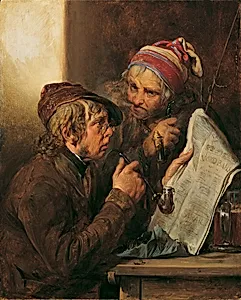
Eng hocken die Fuhrmänner beieinander. „Nordbahn“ ist als Schlagzeile in der Zeitung zu lesen. Gemeint ist die Kaiser Ferdinands-Nordbahn, über deren Bau berichtet wird. Der erste Abschnitt bis Deutsch-Wagram war seit 1838 in Betrieb. Im Entstehungsjahr des Bildes 1840 folgte die Strecke Brünn/Brno–Wien, 1841 kommt Olmütz/Olomouc hinzu. Immer weiter baute man die Eisenbahn aus, um Personen und Güter günstiger und schneller zu transportieren. Doch zeigt Danhauser nicht die Errungenschaften des Fo...
Art Historical Context
In 1840, Austrian painter Josef Danhauser captured a poignant moment of societal upheaval in *Die Zeitungsleser* (The Newspaper Readers), a small oil-on-wood panel measuring just 21 x 17 cm, now housed in Vienna's Belvedere Collection. The intimate scale and detailed medium suit this Biedermeier-era genre scene, allowing for meticulous rendering of everyday textures—from the men's weathered faces to the crumpled newsprint they huddle over. The headline "Nordbahn" refers to the Kaiser Ferdinands-Nordbahn, Austria's pioneering railway line, with segments opening from Deutsch-Wagram in 1838, to Brünn/Brno–Vienna in 1840, and Olmütz/Olomouc in 1841. Danhauser doesn't celebrate industrial progress but exposes its human cost. The clustered draymen (cart drivers), reading intently, embody quiet despair as railways revolutionize transport, slashing costs and speeds for passengers and goods—while robbing them of livelihoods. This social commentary reflects mid-19th-century anxieties amid the Industrial Revolution, where technological "advances" propelled many traditional workers toward poverty and the poorhouse. A master of narrative realism, Danhauser invites viewers to empathize with the overlooked, turning a modest news-reading scene into a timeless critique of change.