
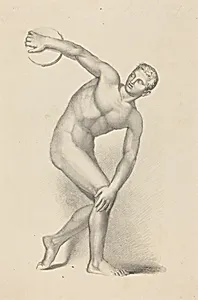
Discobulus, by Myron
published 1829
Medium
lithograph [proof before letters]
Dimensions
sheet: 26.5 × 18.8 cm (10 7/16 × 7 3/8 in.)
Classification
Department
CG-E
Museum
National Gallery of Art, Washington, D.C.
Credit
Rosenwald Collection
Accession Number
1980.45.1700
Rights
Public Domain
Art Historical Context
Behold the *Discobolus* (Discus Thrower), a icon of ancient Greek artistry immortalized here in a delicate 1829 lithograph James William Giles, after neoclassical designs of John Flaxman. The original bronze statue by Myron (c. 480–440 BCE) captures a nude athlete frozen mid-motion, coiled to hurl his discus. This revolutionary work exemplifies the classical ideal of harmonious anatomy and dynamic tension, celebrating the human form's potential during Athens's Golden Age—a period when sculpture evolved from rigid rigidity to fluid grace. Giles's lithograph, a proof before letters from the National Gallery of Art's Rosenwald Collection (sheet: 26.5 × 18.8 cm), reproduces Flaxman's precise outlines with the innovative grease crayon technique of lithography. Emerging in the early 19th century, this medium allowed affordable, detailed dissemination of classical motifs amid Europe's neoclassical revival, fueling Romantic fascination with antiquity. As a "proof before letters"—an unlettered trial print—it offers a pure glimpse into the creative process, unadorned by title or publisher marks. This print bridges millennia, reminding us how Myron's vision of poised power inspired generations, from Renaissance rediscoveries to modern athletics. A gem for print enthusiasts, it underscores the enduring allure of the classical body in art.