
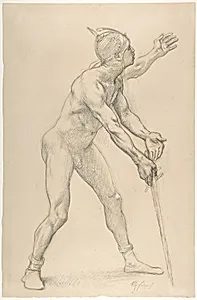
Nude Male Figure with a Sword
Medium
Black chalk
Dimensions
19 7/16 x 12 11/16 in. (49.3 x 32.3cm)
Classification
Drawings
Department
Drawings and Prints
Museum
Metropolitan Museum of Art, New York, NY
Credit
Purchase, Karen B. Cohen Gift, 1988
Accession Number
1988.255
Rights
Public Domain
Tags
Art Historical Context
In the late 19th century, academic artist Alexandre Cabanel was a leading figure in the Parisian art world, renowned for polished, idealized depictions of the human form that echoed classical antiquity. His *Nude Male Figure with Sword* (1878), a masterful black chalk drawing, exemplifies his skill in preparatory studies for larger paintings or sculptures. Created during the height of the Salon tradition, this work likely served as an anatomical exercise, capturing the heroic musculature and poised dynamism of a male nude wielding a sword—a motif evoking ancient warriors or mythological heroes. Black chalk, Cabanel's chosen medium here, was prized by 19th-century draftsmen for its velvety tonal range and ability to render soft shadows and subtle contours. Measuring 19 7/16 x 12 11/16 inches, the drawing showcases precise hatching and blending techniques that highlight the figure's contrapposto stance and tensed grip on the blade, emphasizing anatomical realism honed through life drawing sessions at the École des Beaux-Arts, where Cabanel taught. Housed in the Metropolitan Museum of Art's Drawings and Prints department (Purchase, Karen B. Cohen Gift, 1988), this piece reflects the era's fascination with male nudes as symbols of strength and virtue, bridging Renaissance ideals with modern academic rigor. Visitors will appreciate its intimate scale and timeless celebration of the body's power.
About the Artist
Alexandre Cabanel · 1823–1889
Alexandre Cabanel was a leading French academic painter born on September 28, 1823, in Montpellier. The son of a carpenter, he displayed artistic talent early and began formal training at age eleven at the local École des Beaux-Arts under Charles François Matet. In 1839 he received a municipal scholarship that enabled him to move to Paris, where he enrolled at the École des Beaux-Arts in 1840 and ...