
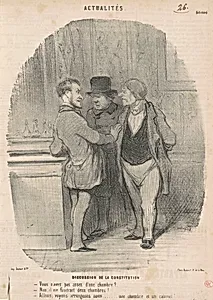
Discussion de la constitution
1848
Medium
lithograph
Classification
Department
CG-E
Museum
National Gallery of Art, Washington, D.C.
Credit
Corcoran Collection (Gift of Dr. Armand Hammer)
Accession Number
2015.143.420
Rights
Public Domain
Art Historical Context
**Discussion de la constitution**, a poignant lithograph by Honoréumier from 1848, captures fervor of France's revolutionary year. Created amid the upheavals of the February Revolution that toppled King Louis-Philippe and birthed the Second Republic, print depicts heated debates over the new constitution in the National Assembly. Daier, a master satirist, uses sharp exaggeration to critique the politicians' bombast, reflecting the era's chaotic push for democratic reforms like universal male suffrage. As a lithograph—a printing technique Daumier perfected for affordable, mass circulation—this work exemplifies his Realism-infused caricature style. Drawn directly on stone with greasy crayon, the medium allowed intricate details and tonal depth, making political commentary accessible to the working class. Daumier's over 4,000 lithographs often skewered the powerful, earning him brief imprisonment earlier for similar barbs. Now part of the National Gallery of Art's Corcoran Collection (gift of Dr. Armand Hammer), this piece endures as a vivid snapshot of 19th-century political theater, reminding us how art can both document and deflate history's grand moments.
About the Artist
Honoré Daumier · 1810–1879
Honoré-Victorin Daumier (1808-1879) was a prolific French printmaker, caricaturist, painter, and sculptor whose works offered incisive commentary on the social and political life of 19th-century France. Known as the 'Michelangelo of Caricature,' Daumier produced over 4,000 lithographs, 500 paintings, 1,000 drawings, and 100 sculptures during his lifetime. His biting political satire led to his imp...