
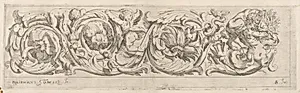
Disegni Varij di Polifilo Zancarli (Friezes)
Medium
etching
Dimensions
Plate: 4 15/16 x 17 5/16 in. (12.6 x 43.9 cm)
Classification
Prints|Ornament & Architecture
Department
Drawings and Prints
Museum
Metropolitan Museum of Art, New York, NY
Credit
The Elisha Whittelsey Collection, The Elisha Whittelsey Fund, 1949
Accession Number
49.20.13(13)
Rights
Public Domain
Tags
Art Historical Context
"Disegni Varij di Polifilo Zanc (Friezes)" is a captivating etching from around 1625, attributed to the Venetian artist Odoardo Fialetti, who often worked under the pseudonym Polifiloancarli for his ornamental designs. Measuring about 5 by 17 inches, this belongs to a tradition of printed pattern books that served architects, sculptors, and decorators during the Baroque era. Housed in the Metropolitan Museum of Art's Drawings and Prints department, it exemplifies the era's fascination with elaborate friezes—continuous decorative bands used in architecture and interiors. The composition bursts with playful yet fantastical motifs: chubby putti (cherubic children), majestic lions, and mischievous satyrs, blending mythological whimsy with grotesque ornamentation. Etching, a technique where acid etches lines into a metal plate for intricate detail, allowed Fialetti to capture fluid, dynamic forms ideal for replication in stone, stucco, or woodwork. These designs drew from Renaissance grotesques, inspired by ancient Roman frescoes rediscovered in the 15th century. Such prints held immense cultural value as practical tools for disseminating innovative motifs across Europe, influencing everything from palace facades to furniture. Visitors today can appreciate how this work bridges art and craft, reflecting Venice's vibrant role as a hub of design innovation in the early 17th century.
About the Artist
Polifilo Giancarli|Odoardo Fialetti (Italian|Italian) · 1600 |1573 –1625 |1638
active in Venice ca. 1600–1625|Italian, Bologna 1573–1637/38 Venice