
Medium
Hard-paste porcelain
Dimensions
2 11/16 × 15 3/8 in. (6.8 × 39.1 cm)
Classification
Ceramics-Porcelain
Culture
German, Meissen
Department
European Sculpture and Decorative Arts
Museum
Metropolitan Museum of Art, New York, NY
Credit
Gift of Estate of James Hazen Hyde, 1959
Accession Number
59.208.25
Rights
Public Domain
Tags
Art Historical Context
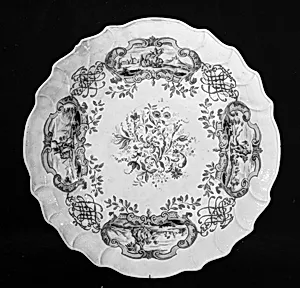
elegant dish presents a harmonious circular composition on its broad surface. At the center, a delicate bouquet of flowers and foliage radiates outward, encircled by four ornate cartouches framed in scrolling acanthus. Each panel depicts a small landscape vignette, linked by trailing garlands and interlaced strapwork that emphasize the scalloped rim. The entire design appears in a refined monochrome palette on luminous white hard-paste porcelain, highlighting the crisp precision of the painted ornament. Produced around 1740 by the Meissen Manufactory, the dish carries decoration attributed to Ignaz Bottengruber and Gottfried Bernhard Goetz. Meissen’s early mastery of true porcelain allowed European artists to rival the finest Asian wares, and this piece exemplifies the inventive blend of floral motifs and narrative scenes that distinguished the factory’s output in the mid-eighteenth century. Its graceful form and intricate painting reflect the period’s taste for refined luxury objects intended for display and refined dining.
About the Artist
Meissen Manufactory|Ignaz Bottengruber|Gottfried Bernhard Goetz · 1710–present
The Meissen Manufactory, established on June 6, 1710, by Augustus the Strong, Elector of Saxony and King of Poland, marked the dawn of true hard-paste porcelain production in Europe. Nestled at Albrechtsburg Castle in Meissen near Dresden, the Royal Polish and Electoral Saxon Porcelain Manufactory arose from alchemical experiments begun in 1708 by physicist Ehrenfried Walther von Tschirnhaus and p...