
Dish
Unknown Artist
early 16th century
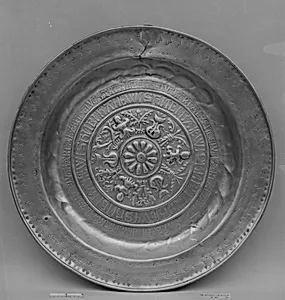
Medium
Brass
Dimensions
Diameter: 16 3/4 in. (42.5 cm)
Classification
Metalwork-Brass
Culture
German
Department
European Sculpture and Decorative Arts
Museum
Metropolitan Museum of Art, New York, NY
Credit
Gift of W. L. Hildburgh, 1932
Accession Number
32.64.30
Rights
Public Domain
Art Historical Context
This elegant brass dish, crafted by an unknown German artisan in the early 16 century, exemplifies the exquisite metalwork of the Northern Renaissance. Measuring 16 3/4 inches (42.5 cm) in diameter, it was likely used for serving food or as a decorative centerpiece in affluent households, showcasing the era's blend of functionality and artistry. Brass, an alloy of copper and zinc, was prized its warm golden hue, durability, and ability to hammered, engraved, or chased—techniques that allowed artisans to create intricate designs reflecting everyday life, heraldry, or biblical motifs. In the context of early 16th-century Germany, such pieces highlight the flourishing craft traditions of cities like Nuremberg, where metalworkers elevated household objects into status symbols. This dish's survival speaks to the high quality of German decorative arts, bridging Gothic and Renaissance styles with robust forms and subtle surface embellishments. Donated to the Metropolitan Museum of Art in 1932 by W. L. Hildburgh, it invites us to appreciate the anonymous skill that made ordinary objects extraordinary, offering a tangible link to Renaissance domestic life.