
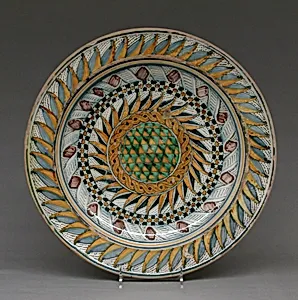
Dish
Unknown Artist
1480–1500
Medium
Maiolica (tin-glazed earthenware)
Dimensions
Overall (confirmed): 3 × 15 1/4 in. (7.6 × 38.7 cm)
Classification
Ceramics-Pottery
Culture
Italian, Deruta
Department
European Sculpture and Decorative Arts
Museum
Metropolitan Museum of Art, New York, NY
Credit
Fletcher Fund, 1946
Accession Number
46.85.17
Rights
Public Domain
Art Historical Context
This exquisite maiolica dish, crafted in Deruta, Italy, between 1480 and 1500, the Renaissance mastery of ceramic art. Measuring a generous 3 × 15¼ inches (7.6 × 38.7 cm), it likely served as a decorative charger or serving platter in affluent households, showcasing the vibrant colors and intricate designs typical of Italian workshops. Deruta, in Umbria, emerged as a leading center for maiolica production during this era, rivaling urban hubs like Florence and Venice. Maiolica, or tin-glazed earthenware revolutionized pottery with its opaque white glaze that provided a smooth canvas for bold metallic oxides—cobalt blue, copper green, and antimony yellow—fired at low temperatures to create luminous, jewel-like effects. This technique, imported from Islamic Spain via Majorca (hence "maiolica"), allowed artists to paint detailed motifs post-glazing, blending utility with high art. Though the maker remains unknown, such pieces reflect the anonymous yet skilled labor of Deruta's botteghe, where innovation met tradition. Housed in the Metropolitan Museum of Art's European Sculpture and Decorative Arts Department (acquired via the Fletcher Fund in 1946), this dish offers a window into late 15th-century Italian domestic luxury, bridging everyday life and artistic ambition. Visitors will appreciate its enduring gleam, a testament to Deruta's legacy in shaping Europe's ceramic heritage.