
Dish
1804–13
Medium
Hard-paste porcelain
Dimensions
Diameter: 9 3/4 in. (24.8 cm)
Classification
Ceramics-Porcelain
Culture
French, Sèvres
Department
European Sculpture and Decorative Arts
Museum
Metropolitan Museum of Art, New York, NY
Credit
Gift of Lewis Einstein, 1962
Accession Number
62.165.38
Rights
Public Domain
Tags
Art Historical Context
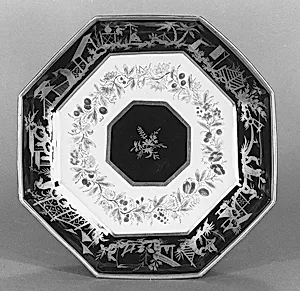
This exquisite dish from the Sèvres Manufactory, between 1804 and 1813, exemplifies the pinnacle of French porcelain artistry during the Napoleonic era Made of hard-paste porcelain—a, translucent material perfected by Sèvres to rival prized Chinese imports—the 9¾-inch diameter piece was produced at the royal factory near, long favored by French monarchs and emperors for its technical innovation and opulent designs. Adorned with chinoiserie motifs of graceful human figures and blooming flowers, the dish captures Europe's enduring fascination with East Asian aesthetics in the 18th and 19th centuries. Chinoiserie, imagined Chinese scenes with European whimsy, was a hallmark of Sèvres' decorative repertoire, showcasing meticulous hand-painting and gilding that highlighted the manufactory's unrivaled skill in firing and enameling. A gift to the Metropolitan Museum of Art from Lewis Einstein in 1962, this dish reflects Sèvres' role in fostering cultural exchange and luxury goods, bridging imperial France with global influences for elite collectors.
About the Artist
Sèvres Manufactory · 1740–present
The Sèvres Manufactory, one of Europe's premier porcelain producers, was established in 1740 as the Manufacture de Vincennes under the patronage of Queen Marie Leszczyńska, who sought to rival Meissen and Chantilly porcelains with French soft-paste innovations. Initially a private venture, it relocated to Sèvres in 1756 in a purpose-built facility designed by architect Laurent Lindet near Madame d...