
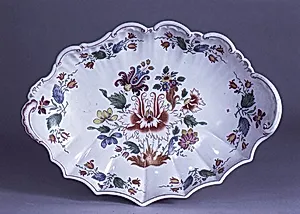
Dish
Medium
Tin-glazed hard-paste porcelain
Dimensions
10 3/4 × 7 5/8 in. (27.3 × 19.4 cm)
Classification
Ceramics-Porcelain
Culture
Italian, Florence
Department
European Sculpture and Decorative Arts
Museum
Metropolitan Museum of Art, New York, NY
Credit
The Charles E. Sampson Memorial Fund, 1973
Accession Number
1973.208
Rights
Public Domain
Tags
Art Historical Context
This elegant dish, created 1760–70 by the Doccia Porcelain Manufactory under Marchese Carlo Ginori, exemplifies the refined artistry of eighteenth-century Florentine ceramics. Founded in 1735 near Florence, the Doccia factory was one of Italy’s earliest producers of high-quality porcelain, blending local innovation with influences from Chinese and Meissen traditions. As a product of this pioneering workshop, the piece reflects the era’s growing European fascination with luxury tableware and decorative arts that elevated everyday objects into statements of taste and status. Crafted in tin-glazed hard-paste porcelain, the medium highlights the technical achievements of the time, allowing for a durable, translucent body with a smooth, luminous surface ideal for delicate floral motifs. The visible flower decoration underscores the period’s appreciation for natural beauty and botanical themes, which were popular in both domestic and courtly settings across Europe. Housed in the Metropolitan Museum of Art’s collection of European Sculpture and Decorative Arts, this work offers visitors a glimpse into the cultural exchanges and craftsmanship that shaped Italian porcelain during the Enlightenment. Its modest yet sophisticated design invites appreciation for the factory’s lasting contribution to the decorative arts.
About the Artist
Doccia Porcelain Manufactory|Marchese Carlo Ginori · 1737–1896
The Doccia Porcelain Manufactory, founded in 1737 by Marquis Carlo Ginori near Florence, holds the distinction of being Italy's first hard-paste porcelain manufacturer and one of the few European porcelain enterprises to survive from the eighteenth century to the present day without interruption. Unlike most contemporary ventures — which depended on the patronage and protection of ruling courts — ...