
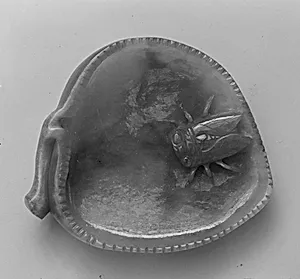
Dish
Unknown Artist
Medium
Jadeite
Dimensions
H. 3 in. (7.6 cm); W. 2 3/4 in. (7 cm)
Classification
Jade
Culture & Period
China · Qing dynasty (1644–1911), Qianlong period (1736–95)
Department
Asian Art
Museum
Metropolitan Museum of Art, New York, NY
Credit
Bequest of Edmund C. Converse, 1921
Accession Number
21.175.101
Rights
Public Domain
Tags
Art Historical Context
This delicate jadeite dish, crafted during the Qianlong period (1736–95) of China's Qing dynasty (16441911), exemplifies the era's mastery of jade carving. Measuring just 3 inches high and 2¾ inches wide, its petite scale suggests it may have served as a luxurious cosmetic container or ritual vessel, reflecting the refined tastes of imperial workshops. The Qianlong emperor, a passionate patron of the arts, oversaw a golden age for jade production, where artisans transformed raw stone into translucent masterpieces symbolizing purity, immortality, and imperial virtue. Jadeite, prized for its vivid green hue and durability, was meticulously carved using abrasives and fine tools to achieve smooth surfaces and intricate details—here, likely featuring motifs of insects, evoking nature's vitality and the harmony of the cosmos in Chinese cosmology. Such carvings demanded extraordinary skill, as the material's toughness allowed for lifelike textures without fractures, showcasing technical prowess honed over centuries. On view in the Metropolitan Museum of Art's Asian Art department, this dish entered the collection through the 1921 bequest of Edmund C. Converse. It invites visitors to marvel at Qing opulence, where everyday objects became emblems of cultural splendor.