
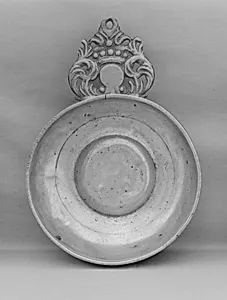
Porringer
Unknown Artist
1770–1830
Medium
Pewter
Dimensions
1 7/8 x 4 5/8 x 4 5/8 in. (4.8 x 11.7 x 11.7 cm)
Classification
Porringer
Department
The American Wing
Museum
Metropolitan Museum of Art, New York, NY
Credit
Gift of Mrs. Russell Sage, 1909
Accession Number
10.125.557
Rights
Public Domain
Art Historical Context
Nestled in The American Wing of the Metropolitan Museum of Art, this unassuming pewter porringer from 1770–1830 offers a glimpse into everyday life in early America. Measuring just 1 7/8 x 4 5/8 x 4 5/8 inches, this small, shallow bowl with its characteristic handle was designed for serving porridge, custards, or broth—staples of colonial and early republican diets. Crafted by an unknown artisan, it exemplifies the practical beauty of pewter, a tin-based alloy prized for its affordability, malleability, and silvery sheen as a silver alternative for middle-class households. Pewter's prominence in 18th- and early 19th-century America stemmed from local workshops that supplied tableware amid growing independence from British imports. This porringer's simple form highlights the craftsmanship of the period, where functionality met subtle elegance without ornate decoration. Donated by Mrs. Russell Sage in 1909, it preserves a tangible link to domestic rituals, reflecting the resourcefulness of American makers during a time of social and economic transformation. Today, such objects remind us how ordinary items shaped cultural identity, bridging the gap between utility and heirloom status in the young nation's homes.