
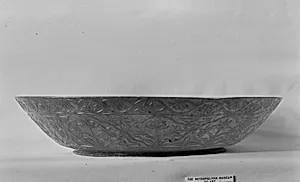
Dish
Unknown Artist
Medium
Nephrite, sage-green of yellowish tint and tiny opaque white spots simulating rice-meal disseminated through it
Dimensions
H. 2 5/16 in. (5.9 cm); W. 11 1/4 in. (28.5 cm)
Classification
Jade
Culture & Period
China · Qing dynasty (1644–1911), Qianlong period (1736–95)
Department
Asian Art
Museum
Metropolitan Museum of Art, New York, NY
Credit
Gift of Heber R. Bishop, 1902
Accession Number
02.18.643
Rights
Public Domain
Art Historical Context
This elegant jade dish, crafted during China's Qing dynasty Qianlong period (173695), exemplifies the imperial era's mastery of nephrite carving. Made from rare sage-green nephrite with a yellowish tint and delicate opaque white spots resembling disseminated rice grains, the dish measures just 2 5/16 inches high and 1/4 inches wide. Its shallow, oval form suggests it served both practical and ceremonial purposes, perhaps for offering delicacies at court banquets. The Qianlong emperor's passion for the arts elevated jade craftsmanship to new heights, with workshops producing objects that blended natural beauty with virtuoso techniques. Nephrite, sourced from distant mountains and revered for its toughness and translucency, was meticulously selected here for its unique "rice-meal" inclusions—a natural phenomenon prized by connoisseurs for evoking abundance and purity. Though the artist remains unknown, the dish reflects the period's emphasis on flawless execution and subtle elegance. In Chinese culture, jade symbolized virtue, immortality, and harmony, making such vessels cherished heirlooms. Donated to the Metropolitan Museum of Art in 1902 by Heber R. Bishop, this treasure invites us to ponder the emperor's opulent world, where even a simple dish embodied cosmic perfection.