
Dish
Unknown Artist
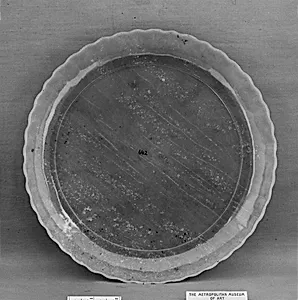
Medium
Nephrite, light sage-green veined and specked with white and sprinkled with some black spots
Dimensions
H. 1 3/16 in. (3 cm); W. 10 7/8 in. (27.7 cm)
Classification
Jade
Culture & Period
China · Qing dynasty (1644–1911), Qianlong period (1736–95)
Department
Asian Art
Museum
Metropolitan Museum of Art, New York, NY
Credit
Gift of Heber R. Bishop, 1902
Accession Number
02.18.642
Rights
Public Domain
Art Historical Context
This elegant jade dish, crafted during China's Qing dynasty Qianlong period (173695), exemplifies the imperial era's reverence for nephrite—a tough, precious stone revered for millennia as a symbol of purity, immortality, and moral virtue. Carved from a single block light sage-green nephrite, veined and speckled with white and accented by black spots, the dish measures a delicate 1 3/16 inches high and 10 7/8 inches wide. Its shallow, wide form suggests use as a ritual vessel, perhaps for offerings, cosmetics, or elite display, highlighting the artisan's mastery in shaping the unyielding material without flaws. Jade carving reached extraordinary heights under Emperor Qianlong, a passionate collector who expanded imperial workshops to produce flawless objects blending utility and artistry. Nephrite's natural mottling here enhances its organic beauty, a prized aesthetic in Chinese jade tradition where the stone's "spirit" (yu qi) was as vital as technical skill. Techniques involved grinding with abrasives and polishing to a luminous sheen, transforming raw boulders into treasures fit for the palace. A gift to the Metropolitan Museum of Art from Heber R. Bishop in 1902, this dish invites visitors to appreciate the subtle drama of nature harnessed by human ingenuity, bridging ancient craftsmanship with timeless elegance.