
Dish
Unknown Artist
16th century
Medium
Stonepaste; underglaze painted in black, blue, and green with red slip
Dimensions
H. 2 1/2 in. (6.4 cm) Diam. 15 5/16 in. (38.9 cm) Wt. (>42 oz)
Classification
Ceramics
Department
Islamic Art
Museum
Metropolitan Museum of Art, New York, NY
Credit
Edward C. Moore Collection, Bequest of Edward C. Moore, 1891
Accession Number
91.1.93
Rights
Public Domain
Tags
Art Historical Context
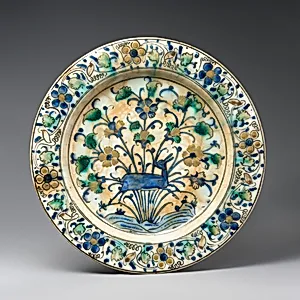
This elegant stonepaste dish, created in the 16th century, exemplifies the refined ceramic traditions of the Islamic world. Housed in the Metropolitan Museum of Art’s Department of Islamic Art, the piece measures just over 15 inches in diameter and features a shallow, open form ideal for serving or display. Its unknown maker employed underglaze painting in black, blue, and green, accented with red slip—a technically demanding method that allowed vibrant colors to fuse beneath a protective glaze during firing. The dish’s decorative program highlights graceful deer amid floral motifs, blending naturalistic observation with stylized ornament typical of the period. Stonepaste, a quartz-based body prized for its smooth surface and luminosity, enabled the intricate detailing seen here. Such works reflect the cultural importance of ceramics in Islamic societies, where they served both practical and aesthetic roles in daily life and courtly settings. Acquired through the 1891 bequest of Edward C. Moore, this vessel invites viewers to appreciate the harmony of form, color, and motif that has long defined Islamic ceramic art.