
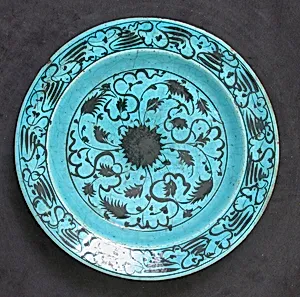
Dish
Unknown Artist
16th–17th century
Medium
Stonepaste; painted in black under turquoise glaze
Dimensions
Diam. 10 3/4 in. (27.3 cm)
Classification
Ceramics
Department
Islamic Art
Museum
Metropolitan Museum of Art, New York, NY
Credit
Theodore M. Davis Collection, Bequest of Theodore M. Davis, 1915
Accession Number
30.95.169
Rights
Public Domain
Art Historical Context
This elegant dish, crafted by an unknown artist in the16th–17th, exemplifies the masterful ceramics of the Islamic world, likely from Persia during the Safavid era. Measuring 10¾ inches in diameter, it belongs to the Metropolitan Museum of Art's Islamic Art collection, gifted through the Theodore M. bequest in 1915. Such vessels were prized household items, blending utility with artistry in grand dining settings. The dish's medium—stonepaste, or fritware—represents a pivotal Islamic innovation, a fine, white body composed of quartz, clay, and glass frit that mimicked Chinese porcelain, unavailable in the region. Artisans painted intricate black designs under a vibrant turquoise glaze, fired to fuse the colors permanently. This underglaze technique ensured durability while allowing luminous blues that symbolized paradise in Islamic culture, showcasing technical prowess and aesthetic refinement. Though the specific motifs are not detailed here, these dishes often featured floral or geometric patterns reflecting Islamic aniconism and mathematical precision. A testament to cross-cultural exchange along the Silk Road, it invites visitors to appreciate the enduring legacy of Islamic craftsmanship.