
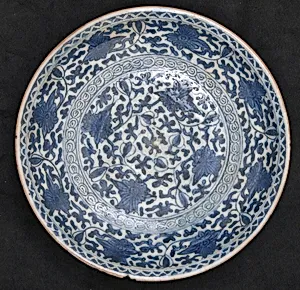
Dish
Unknown Artist
17th century
Medium
Earthenware; glazed
Dimensions
H. 1 7/8 in. (4.8 cm) Diam. 9 in. (22.9 cm)
Classification
Ceramics
Department
Islamic Art
Museum
Metropolitan Museum of Art, New York, NY
Credit
Harris Brisbane Dick Fund, 1966
Accession Number
66.107.3
Rights
Public Domain
Art Historical Context
This elegant 17th-century dish, crafted from glazed earthenware, exemplifies the refined ceramic traditions of the Islamic world. just under 2 inches high and9 inches in diameter, shallow form was ideal for serving sweets, fruits, or spiced delicacies in affluent households. Produced during a golden age of Islamic art—spanning the Ottoman Empire,avid Persia, and Mughal—such vessels highlight the era's vibrant trade networks and cultural exchanges along the Silk Road, where pottery techniques evolved from ancient Mesopotamian roots. The use of earthenware, a durable yet accessible clay body, combined with a glossy glaze, was a hallmark innovation in Islamic ceramics. This glazing process not only rendered the dish impermeable to liquids but also provided a smooth canvas for vibrant polychrome decorations, often featuring floral motifs, calligraphy, or geometric patterns symbolizing paradise gardens from Islamic lore. Though the artist remains unknown, the craftsmanship reflects masterful control of kilns reaching over 1,000°C, ensuring longevity and beauty. Acquired through the Harris Brisbane Dick Fund in 1966, this dish now graces the Metropolitan Museum of Art's Islamic Art department. It invites visitors to appreciate how everyday objects embodied spiritual and aesthetic ideals, bridging utility and artistry in a bustling multicultural epoch.