
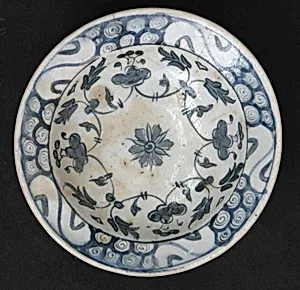
Footed Bowl
Unknown Artist
16th century
Medium
Stonepaste; painted under transparent glaze
Classification
Ceramics
Department
Islamic Art
Museum
Metropolitan Museum of Art, New York, NY
Credit
Gift of Marilyn Jenkins, in memory of her father, Dr. Arthur M. Jenkins, 1982
Accession Number
1982.478.5
Rights
Public Domain
Art Historical Context
Nestled in the Islamic Art collection at the Metropolitan Museum of Art, this elegant *Footed Bowl* from 16th century exemplifies refined ceramic traditions of the Islamic world.ed by an unknown artist it hails from a golden age of pottery production across regions like the Ottoman Empire, Safavid Iran, and Mughal India, where such vessels served both practical purposes—like holding fruits or sweets—and decorative roles in grand households. The bowl's medium, stonepaste (also known as fritware), was a hallmark innovation of Islamic potters from the 9th century onward. This artificial porcelain-like body, made from quartz, clay, and frit, allowed for exceptional translucency and durability, rivaling imported Chinese porcelain that was highly prized but scarce. Artisans painted intricate designs under a transparent glaze, firing the piece to fuse colors vividly beneath a glossy sheen. This underglaze technique preserved motifs through daily use, often featuring floral patterns, calligraphy, or geometric forms symbolizing paradise gardens or divine order. A gift to the Met in 1982 from Marilyn Jenkins in memory of her father, Dr. Arthur M. Jenkins, this bowl invites us to appreciate the anonymous mastery behind Islamic ceramics—where form, function, and artistry harmonized to elevate everyday beauty.