
Dish
Unknown Artist
15th–16th century
Medium
Earthenware; tin-glazed and luster-painted
Dimensions
H. 2 5/8 in. (6.7 cm) Diam. 16 7/8 in. (42.9 cm)
Classification
Ceramics
Department
Islamic Art
Museum
Metropolitan Museum of Art, New York, NY
Credit
Gift of Dr. and Mrs. Lewis Balamuth, 1968
Accession Number
68.215.3
Rights
Public Domain
Tags
Art Historical Context
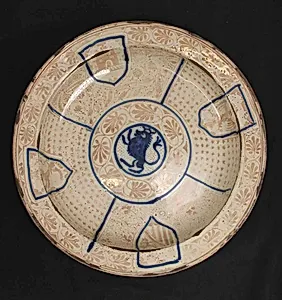
This stunning 15th–16th century dish, crafted from earthenware with a tin-glaze and luster-painting, exemplifies the exquisite ceramics of the Islamic world. Measuring nearly 17 inches in diameter only about 2.5 inches high, its shallow form was ideal for serving communal dishes of fruits, sweets, or spiced delicacies in affluent households. The shimmering luster—a metallic iridescence achieved by applying metallic oxides over the glaze and firing in a reduced-oxygen kiln—created a jewel-like glow, a technique perfected by Islamic potters since the 9th century and highly prized across Mediterranean cultures. Housed in the Metropolitan Museum of Art's Islamic Art Department (gift of Dr. and Mrs. Lewis Balamuth, 1968), the dish likely features motifs of animals and insignia, common in luxury wares from regions like Spain's Hispano-Moresque workshops or the Ottoman Empire. These decorative elements blended naturalistic imagery with symbolic heraldry, reflecting cultural exchanges during a vibrant era of trade and patronage before and after the 1492 fall of Granada. Animals often symbolized power or folklore, while insignia hinted at noble commissions or export to European courts. As a testament to Islamic ceramic innovation, this piece highlights how artisans elevated everyday earthenware into status symbols, influencing Italian maiolica and beyond. Visitors, imagine its luster catching candlelight at a lavish banquet—art that nourished both body and eye.