
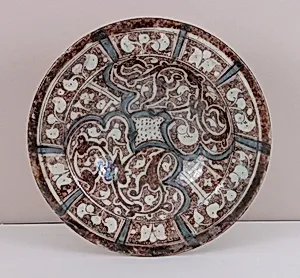
Footed Bowl
Unknown Artist
late 12th–first half 13th century
Medium
Stonepaste; underglaze painted in blue, luster-painted on transparent glaze
Dimensions
H. 4 in. (10.2 cm) Diam. 8 1/2 in. (21.6 cm)
Classification
Ceramics
Department
Islamic Art
Museum
Metropolitan Museum of Art, New York, NY
Credit
H.O. Havemeyer Collection, Gift of Horace Havemeyer, 1948
Accession Number
48.113.11
Rights
Public Domain
Art Historical Context
This exquisite **Footed Bowl**, dating to the late 12 to first half of the 13 century, exemplifies the pinnacle of medieval Islamic ceramics. Standing just 4 inches (10.2 cm) high with an 8½-inch (21.6 cm), its raised foot and wide, shallow form made it ideal for serving food or drink in affluent households across the Islamic world, likely in regions like Persia or Syria during the Seljuk era. Crafted from stonepaste—a fine, white frit body invented by Islamic potters to mimic porcelain's translucency—the bowl features underglaze painting in cobalt blue and shimmering luster applied over a transparent glaze. These techniques, perfected in the 12th century, created a luxurious metallic iridescence through controlled reduction firing, evoking gold and silver vessels while showcasing the era's technical mastery and trade in pigments from afar. Housed in the Metropolitan Museum of Art's Islamic Art department as part of the H.O. Havemeyer Collection (gift of Horace Havemeyer, 1948), this anonymous work highlights how ceramics became high art in Islamic culture, blending everyday utility with opulent decoration for both earthly and symbolic delight.