
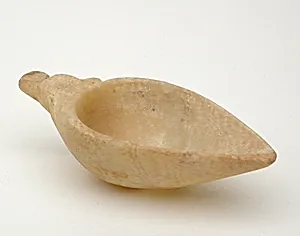
Dish
Third Intermediate Period, Dynasty 21–25 (?) (about 1069–664 BCE)
Medium
Travertine (Egyptian alabaster)
Dimensions
2.5 × 9.8 × 5.1 cm (1 × 3 7/8 × 2 in.)
Classification
vessel
Department
Arts of Africa
Museum
Art Institute of Chicago
Accession Number
136420
Rights
Public Domain
Art Historical Context
This delicate dish, crafted from travertine—commonly called Egyptian alabaster—dates to Egypt’s Third Intermediate Period, roughly 1069–664 BCE. Though small in scale, measuring just over three inches across, the vessel reflects the refined stoneworking traditions that persisted through a time of political change following the New Kingdom. Artisans shaped the soft, creamy stone with remarkable precision, creating smooth surfaces that highlight alabaster’s natural translucency and subtle veining. In ancient Egypt, such vessels often served both practical and ceremonial roles, holding oils, cosmetics, or offerings. The choice of travertine was deliberate: its luminous quality made it prized for objects meant to catch and diffuse light, elevating even everyday items into works of quiet beauty. This example, now in the Art Institute of Chicago’s collection, offers visitors a tangible connection to the continuity of Egyptian craftsmanship across centuries.
About the Artist
Ancient Egyptian
Ancient Egyptian artists, a collective of highly skilled artisans spanning over three millennia from the Predynastic period (c. 6000–3150 BC) to the Roman era (30 BC–4th century AD), produced some of humanity's most enduring masterpieces. These anonymous craftsmen, often organized in state-sponsored workshops, lived in dedicated communities like Deir el-Medina near Luxor during the New Kingdom (c....