
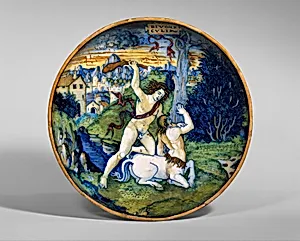
Dish (coppa): Hercules slays the centaur Nessus
Medium
Maiolica (tin-glazed earthenware)
Dimensions
Diam. 9 1/2 in. (24.2 cm)
Classification
Ceramics-Pottery
Department
Robert Lehman Collection
Museum
Metropolitan Museum of Art, New York, NY
Credit
Robert Lehman Collection, 1975
Accession Number
1975.1.1100
Rights
Public Domain
Tags
Art Historical Context
Behold this stunning maiolica dish, or *coppa*, titled *Hercules Slays the Centaur Ness*, crafted in 1525 by Maestro Andreoli, a renowned master of the Gubbio workshops in Renaissance Italy. Measuring 9½ inches in diameter, this tin-glazed earthenware piece vividly captures a dramatic moment from classical mythology: the hero Hercules battling the centaur Nessus, attempted to abduct Hercules' wife, Deianira. The pulses with energy, showcasing the artist's skill in narrative storytelling on everyday tableware. Maiolica, prized for its brilliant colors and glossy finish achieved through tin-glazing and multiple firings, was a hallmark of Italian Renaissance ceramics. Andreoli elevated the medium with his expertise in lusterware techniques, creating shimmering metallic effects that mimic gold and iridescence—perfectly suiting heroic tales from antiquity. Produced during a time when humanist scholars revived Greek and Roman myths, such dishes graced elite dining tables, blending utility with cultural prestige. Now part of the Robert Lehman Collection at The Metropolitan Museum of Art (acquired 1975), this work exemplifies the fusion of artistry and mythology that defined 16th-century Italian pottery. Visitors, imagine it once holding fruit amid lively banquets— a timeless testament to human triumph and technical mastery!
About the Artist
Maestro Giorgio Andreoli · 1500–1550
**Maestro Giorgio Andreoli: The Luster Maestro of Gubbio** Giorgio di Pietro Andreoli, known as Maestro Giorgio or Mastro Giorgio da Gubbio, was born between 1465 and 1470 in Intra on Lake Maggiore, the son of potter Pietro Andreoli. After spending his youth in Pavia—where he was noted in documents as "son of Pietro da Pavia"—his family fled following the 1476 assassination of Duke Galeazzo Sforz...