
Dish Depicting Lady with a Parasol
ca. 1734–37
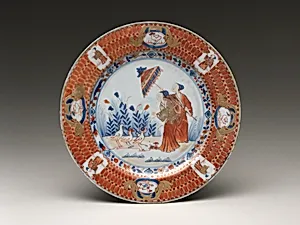
Medium
Porcelain painted with cobalt blue under and colored enamels over transparent glaze (Hizen ware; Imari type)
Dimensions
H. 1 in. (2.5 cm); Diam. 9 3/8 in. (23.9 cm)
Classification
Ceramics
Culture & Period
Japan · Edo period (1615–1868)
Department
Asian Art
Museum
Metropolitan Museum of Art, New York, NY
Credit
Dr. and Mrs. Roger G. Gerry Collection, Bequest of Dr. and Mrs. Roger G. Gerry, 2000
Accession Number
2002.447.122
Rights
Public Domain
Tags
Art Historical Context
This elegant dish, created around 1734–37, showcases the remarkable collaboration between European design and Japanese craftsmanship during the height of global trade. Dutch artist Cornelis Pronk, commissioned by the Dutch East India Company, produced detailed watercolor drawings that were sent to Japan for execution in porcelain. The central scene of a lady with a parasol, accompanied by birds and flowering plants, reflects the refined, decorative style Pronk developed to appeal to European tastes while adapting to the production methods of Hizen kilns. Made in the Imari style of Arita, the dish employs cobalt blue painted under the glaze for the outlines, followed by vibrant overglaze enamels in colors such as red, green, and gold. This technique, perfected in Japan’s Edo period, allowed for luminous, durable decoration that traveled well across oceans. The piece thus embodies the cultural exchange of the time, when Japanese porcelain makers responded to foreign patterns while maintaining their technical excellence. Today in the Metropolitan Museum’s collection, the dish highlights how 18th-century trade networks shaped art. Its modest scale and graceful composition invite close viewing, revealing the delicate balance of European figural elegance and Japanese precision in ceramic art.
About the Artist
Cornelis Pronk · 1691–1759
Comment on works: Portraits; Views; Landscapes; Interiors