
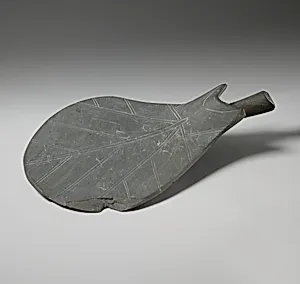
Dish in the shape of a leaf
Unknown Artist
ca. 3100–2900 B.C.
Medium
Greywacke
Dimensions
L. 19.1 x W. 11.3 x D. 2.5 cm (7 1/2 x 4 7/16 x 1 in.)
Classification
Dish, lotus leaf
Period
Early Dynastic Period
Department
Egyptian Art
Museum
Metropolitan Museum of Art, New York, NY
Credit
Rogers Fund, 1919
Accession Number
19.2.17
Rights
Public Domain
Tags
Art Historical Context
This delicate dish, carved in the shape of a leaf during Egypt's Early Dynastic Periodca. 3100–2900 B.C.), the masterful stoneworking of Dynasty 1. Fashioned from greywacke—a hard, fine-grained stone quarried from distant regions like the Eastern Desert—this shallow vessel measures about 19 cm long, perfect for holding oils, cosmetics, or ritual offerings. Its naturalistic form captures the vein-like textures and subtle curves of a real leaf, showcasing the era's advanced lapidary techniques using copper tools and abrasives. In the formative years of unified Egypt under the first pharaohs, such vessels symbolized both elite craftsmanship and a reverence for nature's forms. Produced in royal workshops, they reflect the transition from Predynastic pottery to enduring stone artifacts, signaling growing political stability and artistic sophistication. Leaf-shaped dishes like this one highlight early Egyptians' keen observation of the natural world, possibly evoking fertility or renewal in daily or ceremonial life. Today, housed in the Metropolitan Museum of Art's Egyptian Art department (acquired via the Rogers Fund in 1919), it invites us to marvel at ancient ingenuity—transforming unyielding stone into something as graceful as a leaf fluttering in the Nile breeze.