
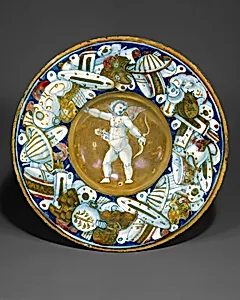
Dish (tondino)
Unknown Artist
ca. 1530
Medium
Maiolica (tin-glazed earthenware)
Dimensions
Diameter: 9 3/16 in. (23.4 cm)
Classification
Ceramics-Pottery
Culture
Italian, Gubbio
Department
Robert Lehman Collection
Museum
Metropolitan Museum of Art, New York, NY
Credit
Robert Lehman Collection, 1975
Accession Number
1975.1.1079
Rights
Public Domain
Tags
Art Historical Context
This charming *Dish (tondino)*, crafted around 1530 in Gubbio, Italy, the Renaissance mastery of maiolica—tin-glazed earthenware allowed for vibrant, painterly decorations on pottery. Measuring just 9 3/16 inches in, this small round dish (tondino) was likely used for serving sweets or preserves, blending functionality with artistry. Produced in Gubbio, a hub for innovative ceramic techniques, it features the iconic tag of Cupid, evoking the playful, amorous themes popular in Italian Renaissance art inspired by classical antiquity. Maiolica from Gubbio was renowned for its lustrous glazes, achieved through a complex process of applying metallic oxides over tin enamel, firing multiple times to create shimmering gold and ruby iridescence that mimicked precious metals. This technical virtuosity elevated everyday objects into luxurious treasures, reflecting the era's fascination with opulence and humanism. Though the artist remains unknown, the dish's survival in the Robert Lehman Collection at The Metropolitan Museum of Art underscores its enduring appeal. Part of the rich tradition of Italian ceramics, this piece captures the cultural vibrancy of 16th-century Italy, where mythology like Cupid symbolized love and desire amid the intellectual revival of the Renaissance. Visitors will appreciate its delicate scale and luminous surface, a testament to Gubbio's pivotal role in Europe's ceramic renaissance.