
Dish (one of a pair)
ca. 1525–35
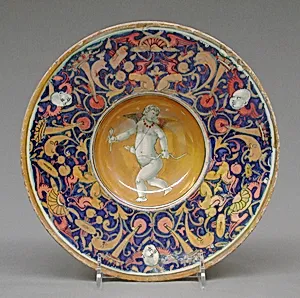
Medium
Maiolica (tin-glazed earthenware), lustered
Dimensions
Overall (confirmed): 2 1/8 x 9 3/8 in. (5.4 x 23.8 cm)
Classification
Ceramics-Pottery
Culture
Italian, Gubbio
Department
European Sculpture and Decorative Arts
Museum
Metropolitan Museum of Art, New York, NY
Credit
Gift of V. Everit Macy, in memory of his wife, Edith Carpenter Macy, 1927
Accession Number
27.97.33
Rights
Public Domain
Tags
Art Historical Context
This exquisite maiolica dish, crafted around 1525–35 in the Umbrian town of Gubbio, represents the height of Italian Renaissance ceramic artistry. Created by Maestro Giorgio Andreoli, whose workshop perfected the difficult technique of metallic luster, the piece glows with an iridescent sheen achieved by applying silver and copper oxides before a final reduction firing. The tin-glazed earthenware surface, painted with delicate figural scenes, reflects the period’s fascination with classical mythology—here featuring Cupid the Roman god of love. Gubbio’s lusterware was prized across Europe for its jewel-like brilliance, often reserved for display in noble households rather than everyday use. As one of a pair, this dish likely formed part of an elaborate service or decorative ensemble, showcasing both technical virtuosity and refined taste. Its generous scale and luminous surface highlight how Renaissance potters elevated humble clay into objects of courtly splendor. Today in the Metropolitan Museum’s collection, the work offers visitors a tangible connection to sixteenth-century Italy, where innovation in materials and a revival of ancient themes merged to create enduring beauty.
About the Artist
Maestro Giorgio Andreoli · 1500–1550
**Maestro Giorgio Andreoli: The Luster Maestro of Gubbio** Giorgio di Pietro Andreoli, known as Maestro Giorgio or Mastro Giorgio da Gubbio, was born between 1465 and 1470 in Intra on Lake Maggiore, the son of potter Pietro Andreoli. After spending his youth in Pavia—where he was noted in documents as "son of Pietro da Pavia"—his family fled following the 1476 assassination of Duke Galeazzo Sforz...