
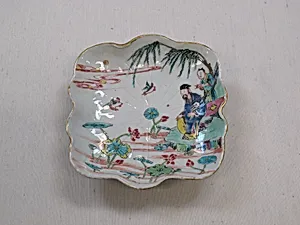
Dish with figures by a lotus pond
Unknown Artist
late 18th century
Medium
Porcelain painted in overglaze polychrome enamels (Jingdezhen ware)
Dimensions
H. 5 1/8 in. (13 cm); W. 4 7/8 in. (12.4 cm)
Classification
Ceramics
Culture & Period
China · Qing dynasty (1644–1911)
Department
Asian Art
Museum
Metropolitan Museum of Art, New York, NY
Credit
Purchase by subscription, 1879
Accession Number
79.2.1022
Rights
Public Domain
Tags
Art Historical Context
This delicate porcelain dish, titled *Dish with Figures by a Lotus Pond*, hails from China's Jingdezhen kilns during the late 18th century, at the height of the Qing dynasty (16441911). Measuring just over 5 inches in height width, it exemplifies the exquisite craftsmanship of imperial porcelain production, where artisans fired high-quality clay bodies to create translucent white surfaces ideal for decoration. The scene depicts men gathered near blooming lotuses and shady trees, evoking a, harmonious moment in nature—a common motif in Chinese art symbolizing purity, prosperity, and scholarly leisure. Painted in overglaze polychrome enamels, the dish showcases a sophisticated technique: vibrant colors like blues, greens, and golds were applied after the initial high-temperature glaze firing, then fixed with a lower-temperature enamel kiln. This method allowed for intricate details and jewel-like hues that wouldn't survive intense heat, making Jingdezhen ware highly prized for both domestic use and export. Lotus ponds, in particular, held deep cultural resonance, representing Buddhist ideals of enlightenment rising from mud. Acquired by the Metropolitan Museum of Art through a public subscription in 1879, this piece reflects early Western fascination with Chinese ceramics. Today, it invites visitors to appreciate the Qing era's technical mastery and poetic celebration of everyday beauty in the natural world.