
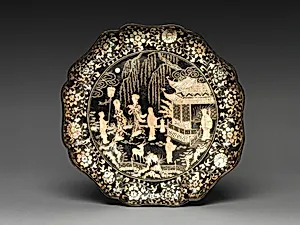
明晚期 黑漆嵌螺鈿人物故事圖葵口盤|Dish with figures in a landscape
Unknown Artist
16th century
Medium
Black lacquer with inlaid mother-of-pearl
Dimensions
H. 1/8 in.; Diam. 10 5/8 in.(27 cm)
Classification
Lacquer
Culture & Period
China · Ming dynasty (1368–1644)
Department
Asian Art
Museum
Metropolitan Museum of Art, New York, NY
Credit
Gift of Florence and Herbert Irving, 2015
Accession Number
2015.500.1.13
Rights
Public Domain
Tags
Art Historical Context
This exquisite late Ming dynasty dish, crafted in the 16th century showcases a vibrant scene of human figures in a lush landscape, complete with houses, graceful deer, and blooming flowers. Measuring just 1/8 inch high and 10 5/8 inches in diameter its lobed, lotus-petal rim (known as *kuikou*) evokes the organic beauty of nature, making it both a functional serving piece and a decorative treasure from imperial China. The artwork's black lacquer ground, meticulously built up in multiple layers, is inlaid with shimmering mother-of-pearl (*luodian*), a technique perfected during the Ming period (1368–1644). Artisans would cut and shape iridescent shell pieces, embedding them into the lacquer before polishing to reveal a luminous, three-dimensional effect that catches the light like jewels. This labor-intensive method highlights the era's mastery of lacquerware, transforming everyday objects into symbols of luxury and refinement for the elite. In Ming culture, such narrative scenes often drew from folklore or daily life, blending humanism with harmony in nature—a hallmark of the dynasty's artistic golden age. Donated to the Metropolitan Museum of Art in 2015 by Florence and Herbert Irving, this anonymous masterpiece invites us to ponder the stories unfolding on its surface, bridging centuries with its enduring elegance.